SUBSCRIBE TO OUR FREE NEWSLETTER
Daily news & progressive opinion—funded by the people, not the corporations—delivered straight to your inbox.
5
#000000
#FFFFFF
To donate by check, phone, or other method, see our More Ways to Give page.
Daily news & progressive opinion—funded by the people, not the corporations—delivered straight to your inbox.

A health insurance claim form is seen on a medical bill.
"Private insurance companies, including Medicare Advantage plans, are designed to generate profit. How do they do that? Take our money and then deny our care."
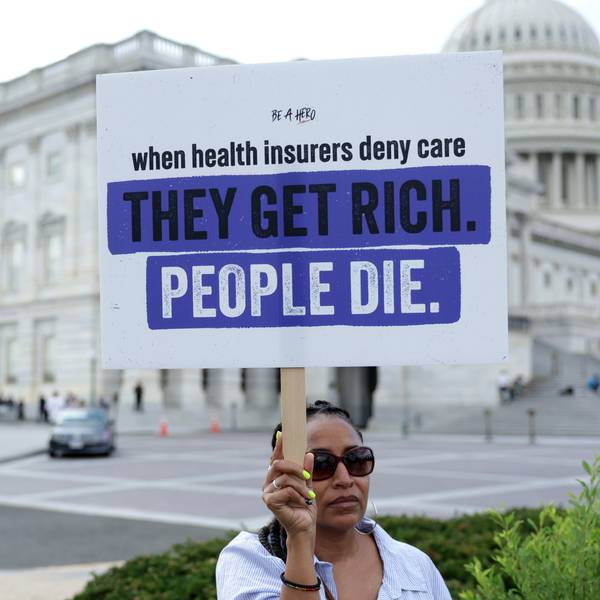
A pair of new stories examining the increasingly common but shadowy U.S. insurance industry practice of refusing to pay for certain treatments drew outrage Wednesday from patient advocates and Medicare for All proponents, who said the reporting further reveals the harms of for-profit healthcare.
The investigative outlet ProPublica focused its attention on the "galling" secrecy around insurance companies' claim denials, which frequently leave patients with massive medical bills and little clarity as to why their claims were rejected.
"How often insurance companies say no is a closely held secret," ProPublica's Robin Fields reported. "There's nowhere that a consumer or an employer can go to look up all insurers' denial rates—let alone whether a particular company is likely to decline to pay for procedures or drugs that its plans appear to cover."
"In 2010, federal regulators were granted expansive authority through the Affordable Care Act to require that insurers provide information on their denials. This data could have meant a sea change in transparency for consumers," Fields added. "But more than a decade later, the federal government has collected only a fraction of what it’s entitled to. And what information it has released, experts say, is so crude, inconsistent, and confusing that it's essentially meaningless."
The data that is available indicates claim denials are on the rise. According to a February KFF study of Affordable Care Act plans, "nearly 17% of in-network claims were denied in 2021."
Elisabeth Rosenthal of KFF Health News wrote in a column last month that declining to pay for patients' treatments is "a handy way for insurers to keep revenue high."
"Millions of Americans in the past few years have run into this experience: filing a healthcare insurance claim that once might have been paid immediately but instead is just as quickly denied," Rosenthal wrote. "If the experience and the insurer's explanation often seem arbitrary and absurd, that might be because companies appear increasingly likely to employ computer algorithms or people with little relevant experience to issue rapid-fire denials of claims—sometimes bundles at a time—without reviewing the patient's medical chart. A job title at one company was 'denial nurse.'"
ProPublica noted Wednesday that "some advocates say insurers have a good reason to dodge transparency."
Citing Wendell Potter, a former Cigna executive who now supports Medicare for All, ProPublica reported that "refusing payment for medical care and drugs has become a staple of their business model, in part because they know customers appeal less than 1% of denials."
"That's money left on the table that the insurers keep," Potter told the outlet.
With their companies' profits booming, the CEOs of the top seven private health insurance giants in the U.S. took home a combined $335 million in compensation last year.
Medicare Advantage providers—private insurers paid by the federal government to cover patient care—have become notorious for denying claims for medically necessary treatments as enrollment in the program continues to surge.
As The Lever's Matthew Cunningham-Cook reported Wednesday, "Medicare Advantage insurers are threatening the foundational premise of the government's healthcare safety net for seniors and people with disabilities: that people in Medicare should get the care that is recommended by a doctor."
"A 2022 investigation by the inspector general of the Department of Health and Human Services found that in 2019, 13% of the total prior authorization requests denied by Medicare Advantage plans would have been covered under traditional Medicare, leading to an estimated 85,000 additional care denials," Cunningham-Cook wrote. "That year, Medicare Advantage plans also wrongly denied 18% of payment claims—covering an estimated 1.5 million claims—reducing the likelihood that doctors will recommend the costliest yet often most effective care, for fear of not being paid."
Social Security Works, a progressive advocacy group that backs Medicare for All, tweeted in response to the new reporting Wednesday that "private insurance companies, including Medicare Advantage plans, are designed to generate profit."
"How do they do that? Take our money and then deny our care," the group added.
Cunningham-Cook opened his piece with the story of Jenn Coffey, a former Republican state representative in New Hampshire "who, like many GOP faithfuls, believed private insurers could solve the healthcare crisis if they were allowed to do things like sell policies across state lines."
But Coffey's views were shaken when UnitedHealth, her ultra-profitable Medicare Advantage provider, "constantly rejected or second-guessed the care options her doctors suggested for her cancer recovery and for a rare and painful secondary disease that has no standard treatment plan," Cunningham-Cook reported.
“Now I've realized that you can't fix or repair the system,” Coffey told The Lever. "The insurance companies don't offer anything. They serve as a roadblock."
"The only way forward," she added, "is Medicare for All."
Dear Common Dreams reader, It’s been nearly 30 years since I co-founded Common Dreams with my late wife, Lina Newhouser. We had the radical notion that journalism should serve the public good, not corporate profits. It was clear to us from the outset what it would take to build such a project. No paid advertisements. No corporate sponsors. No millionaire publisher telling us what to think or do. Many people said we wouldn't last a year, but we proved those doubters wrong. Together with a tremendous team of journalists and dedicated staff, we built an independent media outlet free from the constraints of profits and corporate control. Our mission has always been simple: To inform. To inspire. To ignite change for the common good. Building Common Dreams was not easy. Our survival was never guaranteed. When you take on the most powerful forces—Wall Street greed, fossil fuel industry destruction, Big Tech lobbyists, and uber-rich oligarchs who have spent billions upon billions rigging the economy and democracy in their favor—the only bulwark you have is supporters who believe in your work. But here’s the urgent message from me today. It's never been this bad out there. And it's never been this hard to keep us going. At the very moment Common Dreams is most needed, the threats we face are intensifying. We need your support now more than ever. We don't accept corporate advertising and never will. We don't have a paywall because we don't think people should be blocked from critical news based on their ability to pay. Everything we do is funded by the donations of readers like you. When everyone does the little they can afford, we are strong. But if that support retreats or dries up, so do we. Will you donate now to make sure Common Dreams not only survives but thrives? —Craig Brown, Co-founder |
A pair of new stories examining the increasingly common but shadowy U.S. insurance industry practice of refusing to pay for certain treatments drew outrage Wednesday from patient advocates and Medicare for All proponents, who said the reporting further reveals the harms of for-profit healthcare.
The investigative outlet ProPublica focused its attention on the "galling" secrecy around insurance companies' claim denials, which frequently leave patients with massive medical bills and little clarity as to why their claims were rejected.
"How often insurance companies say no is a closely held secret," ProPublica's Robin Fields reported. "There's nowhere that a consumer or an employer can go to look up all insurers' denial rates—let alone whether a particular company is likely to decline to pay for procedures or drugs that its plans appear to cover."
"In 2010, federal regulators were granted expansive authority through the Affordable Care Act to require that insurers provide information on their denials. This data could have meant a sea change in transparency for consumers," Fields added. "But more than a decade later, the federal government has collected only a fraction of what it’s entitled to. And what information it has released, experts say, is so crude, inconsistent, and confusing that it's essentially meaningless."
The data that is available indicates claim denials are on the rise. According to a February KFF study of Affordable Care Act plans, "nearly 17% of in-network claims were denied in 2021."
Elisabeth Rosenthal of KFF Health News wrote in a column last month that declining to pay for patients' treatments is "a handy way for insurers to keep revenue high."
"Millions of Americans in the past few years have run into this experience: filing a healthcare insurance claim that once might have been paid immediately but instead is just as quickly denied," Rosenthal wrote. "If the experience and the insurer's explanation often seem arbitrary and absurd, that might be because companies appear increasingly likely to employ computer algorithms or people with little relevant experience to issue rapid-fire denials of claims—sometimes bundles at a time—without reviewing the patient's medical chart. A job title at one company was 'denial nurse.'"
ProPublica noted Wednesday that "some advocates say insurers have a good reason to dodge transparency."
Citing Wendell Potter, a former Cigna executive who now supports Medicare for All, ProPublica reported that "refusing payment for medical care and drugs has become a staple of their business model, in part because they know customers appeal less than 1% of denials."
"That's money left on the table that the insurers keep," Potter told the outlet.
With their companies' profits booming, the CEOs of the top seven private health insurance giants in the U.S. took home a combined $335 million in compensation last year.
Medicare Advantage providers—private insurers paid by the federal government to cover patient care—have become notorious for denying claims for medically necessary treatments as enrollment in the program continues to surge.
As The Lever's Matthew Cunningham-Cook reported Wednesday, "Medicare Advantage insurers are threatening the foundational premise of the government's healthcare safety net for seniors and people with disabilities: that people in Medicare should get the care that is recommended by a doctor."
"A 2022 investigation by the inspector general of the Department of Health and Human Services found that in 2019, 13% of the total prior authorization requests denied by Medicare Advantage plans would have been covered under traditional Medicare, leading to an estimated 85,000 additional care denials," Cunningham-Cook wrote. "That year, Medicare Advantage plans also wrongly denied 18% of payment claims—covering an estimated 1.5 million claims—reducing the likelihood that doctors will recommend the costliest yet often most effective care, for fear of not being paid."
Social Security Works, a progressive advocacy group that backs Medicare for All, tweeted in response to the new reporting Wednesday that "private insurance companies, including Medicare Advantage plans, are designed to generate profit."
"How do they do that? Take our money and then deny our care," the group added.
Cunningham-Cook opened his piece with the story of Jenn Coffey, a former Republican state representative in New Hampshire "who, like many GOP faithfuls, believed private insurers could solve the healthcare crisis if they were allowed to do things like sell policies across state lines."
But Coffey's views were shaken when UnitedHealth, her ultra-profitable Medicare Advantage provider, "constantly rejected or second-guessed the care options her doctors suggested for her cancer recovery and for a rare and painful secondary disease that has no standard treatment plan," Cunningham-Cook reported.
“Now I've realized that you can't fix or repair the system,” Coffey told The Lever. "The insurance companies don't offer anything. They serve as a roadblock."
"The only way forward," she added, "is Medicare for All."
A pair of new stories examining the increasingly common but shadowy U.S. insurance industry practice of refusing to pay for certain treatments drew outrage Wednesday from patient advocates and Medicare for All proponents, who said the reporting further reveals the harms of for-profit healthcare.
The investigative outlet ProPublica focused its attention on the "galling" secrecy around insurance companies' claim denials, which frequently leave patients with massive medical bills and little clarity as to why their claims were rejected.
"How often insurance companies say no is a closely held secret," ProPublica's Robin Fields reported. "There's nowhere that a consumer or an employer can go to look up all insurers' denial rates—let alone whether a particular company is likely to decline to pay for procedures or drugs that its plans appear to cover."
"In 2010, federal regulators were granted expansive authority through the Affordable Care Act to require that insurers provide information on their denials. This data could have meant a sea change in transparency for consumers," Fields added. "But more than a decade later, the federal government has collected only a fraction of what it’s entitled to. And what information it has released, experts say, is so crude, inconsistent, and confusing that it's essentially meaningless."
The data that is available indicates claim denials are on the rise. According to a February KFF study of Affordable Care Act plans, "nearly 17% of in-network claims were denied in 2021."
Elisabeth Rosenthal of KFF Health News wrote in a column last month that declining to pay for patients' treatments is "a handy way for insurers to keep revenue high."
"Millions of Americans in the past few years have run into this experience: filing a healthcare insurance claim that once might have been paid immediately but instead is just as quickly denied," Rosenthal wrote. "If the experience and the insurer's explanation often seem arbitrary and absurd, that might be because companies appear increasingly likely to employ computer algorithms or people with little relevant experience to issue rapid-fire denials of claims—sometimes bundles at a time—without reviewing the patient's medical chart. A job title at one company was 'denial nurse.'"
ProPublica noted Wednesday that "some advocates say insurers have a good reason to dodge transparency."
Citing Wendell Potter, a former Cigna executive who now supports Medicare for All, ProPublica reported that "refusing payment for medical care and drugs has become a staple of their business model, in part because they know customers appeal less than 1% of denials."
"That's money left on the table that the insurers keep," Potter told the outlet.
With their companies' profits booming, the CEOs of the top seven private health insurance giants in the U.S. took home a combined $335 million in compensation last year.
Medicare Advantage providers—private insurers paid by the federal government to cover patient care—have become notorious for denying claims for medically necessary treatments as enrollment in the program continues to surge.
As The Lever's Matthew Cunningham-Cook reported Wednesday, "Medicare Advantage insurers are threatening the foundational premise of the government's healthcare safety net for seniors and people with disabilities: that people in Medicare should get the care that is recommended by a doctor."
"A 2022 investigation by the inspector general of the Department of Health and Human Services found that in 2019, 13% of the total prior authorization requests denied by Medicare Advantage plans would have been covered under traditional Medicare, leading to an estimated 85,000 additional care denials," Cunningham-Cook wrote. "That year, Medicare Advantage plans also wrongly denied 18% of payment claims—covering an estimated 1.5 million claims—reducing the likelihood that doctors will recommend the costliest yet often most effective care, for fear of not being paid."
Social Security Works, a progressive advocacy group that backs Medicare for All, tweeted in response to the new reporting Wednesday that "private insurance companies, including Medicare Advantage plans, are designed to generate profit."
"How do they do that? Take our money and then deny our care," the group added.
Cunningham-Cook opened his piece with the story of Jenn Coffey, a former Republican state representative in New Hampshire "who, like many GOP faithfuls, believed private insurers could solve the healthcare crisis if they were allowed to do things like sell policies across state lines."
But Coffey's views were shaken when UnitedHealth, her ultra-profitable Medicare Advantage provider, "constantly rejected or second-guessed the care options her doctors suggested for her cancer recovery and for a rare and painful secondary disease that has no standard treatment plan," Cunningham-Cook reported.
“Now I've realized that you can't fix or repair the system,” Coffey told The Lever. "The insurance companies don't offer anything. They serve as a roadblock."
"The only way forward," she added, "is Medicare for All."